Transactional email API pricing looks simple until you open the tabs. One vendor sells plans, another tiers, a third caps you per day, and some roundups still quote SES at $0.10 per 1,000 for accounts AWS now starts at $0.16.
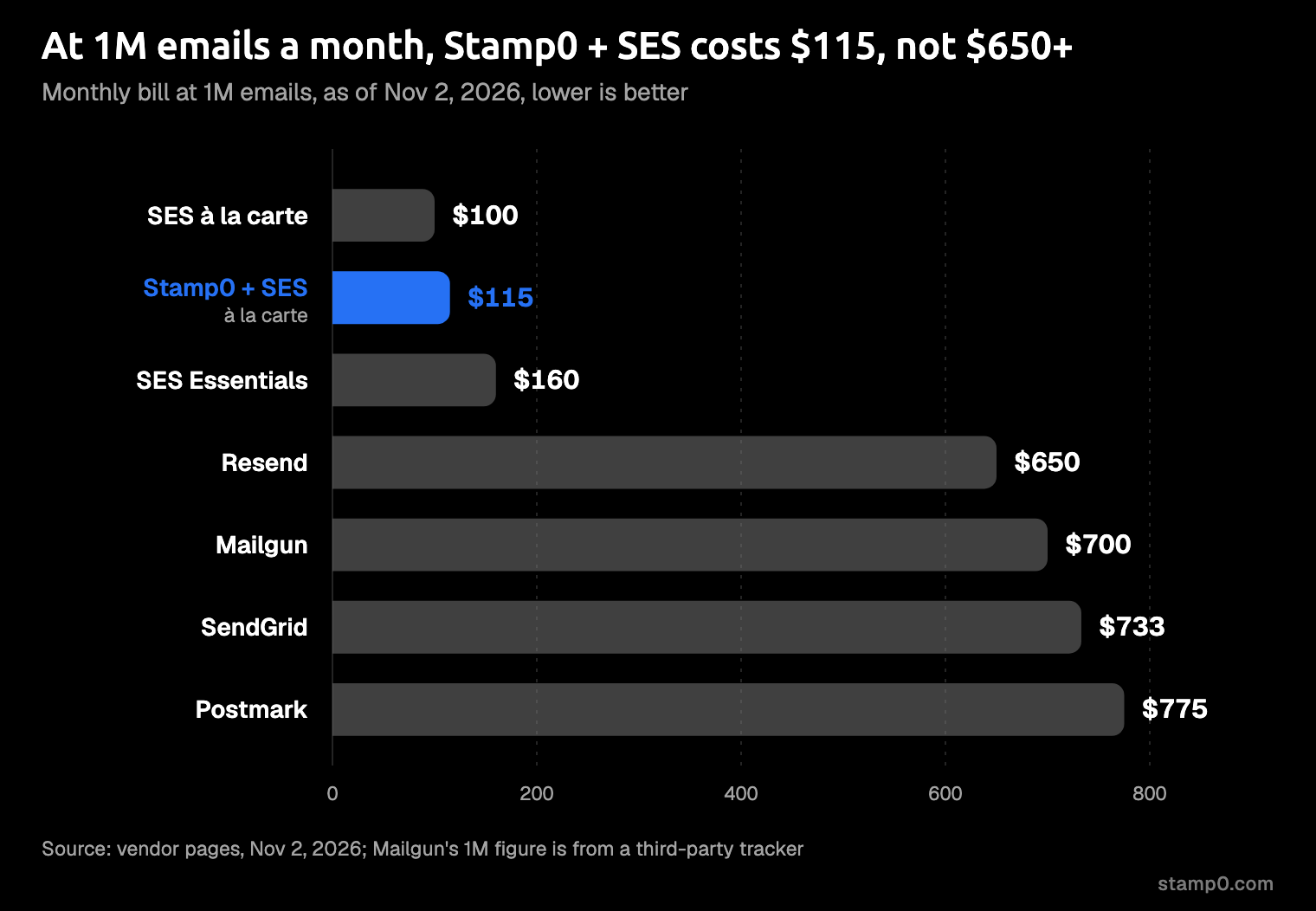
SES is the cheapest per email. Next to the four hosted APIs in this post (Resend, Postmark, SendGrid and Mailgun), Stamp0 plus SES costs the least at every volume we priced. At 1M emails it's $115 a month on SES à la carte, against $650 on Resend. Under 3,000 emails a month, Resend Free wins at $0.
We build Stamp0 and publish this blog, so weigh the pick with that in mind; the sources and the method are below. Anyone who has multiplied an overage rate by their volume has got a number that matches nothing on the pricing page. This post does that arithmetic once, at four volumes, with the method shown.
Transactional email API pricing at 10k, 50k, 100k and 1M
Every provider here except SES prices in steps, so your bill at a given volume is the cheapest plan or tier that covers it. Below a certain size you're paying a minimum fee, not a price per email. Resend's smallest paid plan covers 50k for $20, so a team sending 10k rents a plan that's mostly empty.
Monthly bill on the cheapest plan or tier that covers the volume, as of November 2, 2026; Stamp0's plans are on our pricing page.
| Provider | 10k a month | 50k | 100k | 1M |
|---|---|---|---|---|
| Resend | $20 (Pro) | $20 (Pro) | $35 (Pro) | $650 (Scale) |
| Postmark (Basic) | $15 | $55 | $115 (125k tier) | $775 (1.5M tier) |
| SendGrid | $19.95 (Essentials 50k) | $19.95 (Essentials) | $34.95 (Essentials 100k) | $733 (Pro 700k + overage) |
| Mailgun | $15 (Basic) | $35 (Foundation) | $90 (Scale) | $700 (Scale; see note) |
| SES à la carte | $1.00 | $5.00 | $10.00 | $100.00 |
| SES Essentials (new-account default) | $1.60 | $8.00 | $16.00 | $160.00 |
| Stamp0 + SES à la carte | $1.00 (Free + $1.00 AWS) | $5.00 (Free + $5.00 AWS) | $25.00 (Pro $15 + $10 AWS) | $115.00 (Pro $15 + $100 AWS) |
| Stamp0 + SES Essentials | $1.60 | $8.00 | $31.00 (Pro $15 + $16 AWS) | $175.00 (Pro $15 + $160 AWS) |
Mailgun's page doesn't print its 1M price; the $700 comes from a third-party tracker dated October 2, 2026. Its FAQ also names a Foundation 100k tier but prints no price for it, so the 100k cell is Scale's $90.
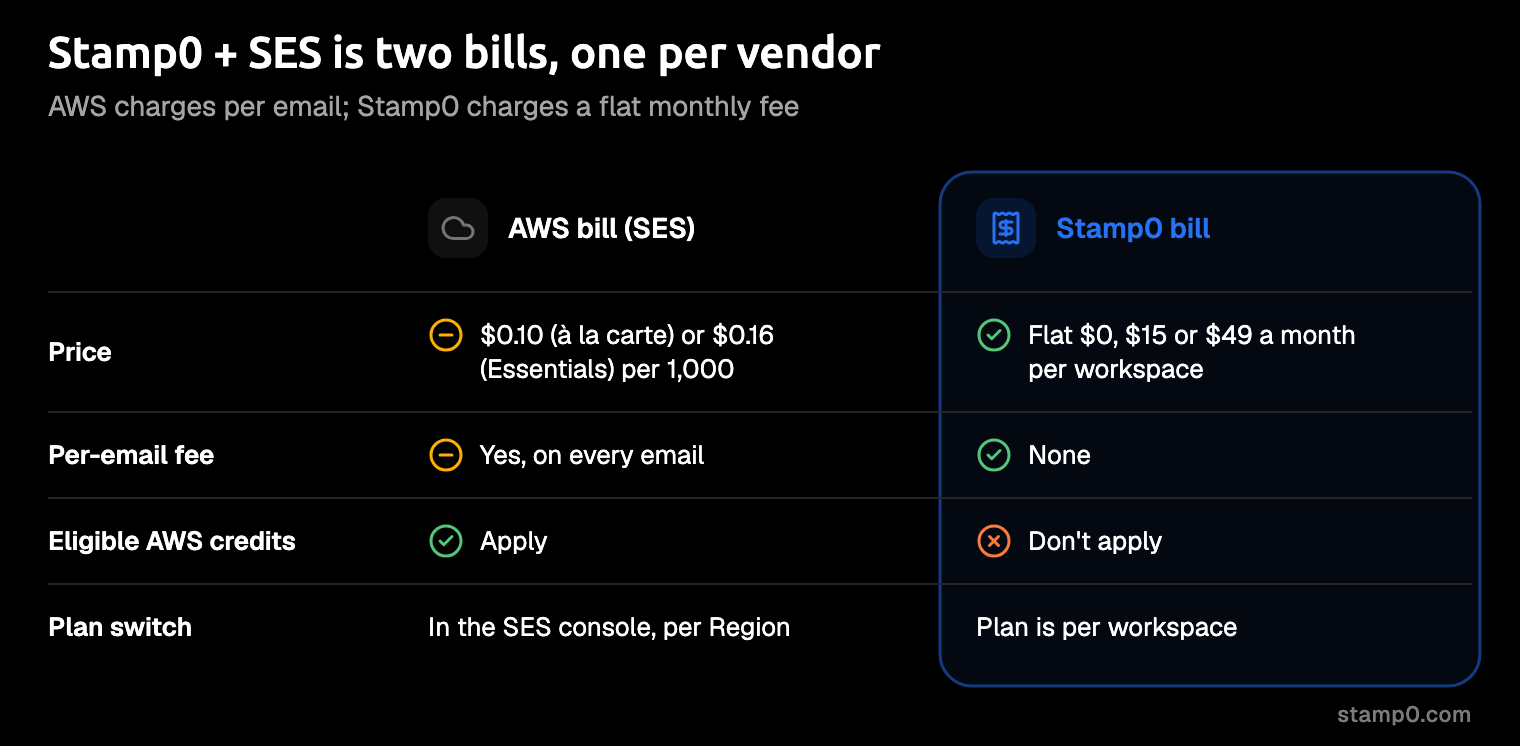
SES and Stamp0 each get two rows because new AWS accounts start SES on Essentials. One switch in the SES console moves you to à la carte (what changed in July 2026). Stamp0's flat $0 to $49 a month per workspace sits on top of your AWS bill.
The per-email story starts once you outgrow the minimums. At a million emails it's the whole story: the four hosted providers land between $650 and $775 a month, against $100 on SES à la carte.
How we priced it
"Starting at" is the least useful number on a pricing page: it tells you what the smallest customer pays. So for each provider we took the cheapest plan or tier that covers the volume, then checked whether a smaller tier plus overage came in under it.
The routes we rejected show how much that choice moves a bill. SendGrid's covering tier at 1M is $799, while its 700k tier plus overage is $733. Postmark at 100k is $115 on the 125k tier, against $145 for the 50k tier plus overage. At 1M, overage would cost $965 on Postmark (against $775 for the 1.5M tier) and $775 on Mailgun (against $700).
We read every vendor page on November 2, 2026: Postmark's full ladder comes from its plain-text pricing file, and SendGrid's from the plan-comparison PDF linked on its pricing page, because neither page shows every tier in its text. Resend's figures match its pricing page as we read it that day.
SES is your volume times the rate. Stamp0 plus SES is the flat plan (Free up to 50,000 emails, Pro at $15 above that) plus your SES bill. Tax is left out, and so is the CloudFormation stack Stamp0 sets up in your AWS account, which costs about $0.40 a month.
Cost per 1,000 emails at each volume
Divide each bill by the thousands you send and the pricing pages stop being poetry. Hosted rates drop steeply once you're past the minimums, then wobble: Resend and SendGrid are cheapest per 1,000 at 100k and dearer again at 1M, while Postmark ticks up at 100k before it falls. SES stays put.
| Provider | 10k a month | 50k | 100k | 1M |
|---|---|---|---|---|
| Resend | $2.00 | $0.40 | $0.35 | $0.65 |
| Postmark (Basic) | $1.50 | $1.10 | $1.15 | $0.775 |
| SendGrid | $1.995 | $0.399 | $0.3495 | $0.733 |
| Mailgun | $1.50 | $0.70 | $0.90 | $0.70 |
| SES à la carte | $0.10 | $0.10 | $0.10 | $0.10 |
| SES Essentials | $0.16 | $0.16 | $0.16 | $0.16 |
| Stamp0 + SES à la carte | $0.10 | $0.10 | $0.25 | $0.115 |
| Stamp0 + SES Essentials | $0.16 | $0.16 | $0.31 | $0.175 |
The hosted four fall from between $1.50 and $2.00 per 1,000 at 10k to between $0.65 and $0.775 at 1M. SES stays at $0.10 or $0.16 at every volume here, depending on your plan. Mailgun's $0.90 at 100k is a gap in its price list rather than a jump: Foundation 100k has no printed price, so Scale is the only plan we could price there.
Stamp0 plus SES has a step at 100k. On Free you pay only SES's à la carte $0.10. At 100k you need Pro, and $15 on top of a $10 AWS bill makes $0.25 per 1,000. Spread over 1M emails, the same $15 is small next to a $100 AWS bill, and the rate falls to $0.115.
Compare per-1,000 at your own volume, never the overage rate on the plan page. A roundup's "cheapest" pick is usually cheapest at somebody else's volume.
Costs that hide behind the headline price
The headline bill covers sending. Four other lines decide whether you still like it a year in: what overage costs, how long logs last, whether receiving mail is included, and what a dedicated IP costs.
| Provider | Overage | Log retention | Inbound | Dedicated IP |
|---|---|---|---|---|
| Resend | $0.90 per 1,000 on Pro; $0.90 to $0.46 on Scale | 30 days | All plans | $30 a month, on Scale |
| Postmark | $1.80 per 1,000 on Basic to 125k, $1.70 above; lower on Pro and Platform | 45 days; up to 365 on Pro and Platform | Pro and Platform; counts toward volume | From $50 a month per IP; needs 300,000+ a month and Pro or higher |
| SendGrid | $0.00133 to $0.00047 per extra email, by tier | 3 days (Essentials), 7 days (Pro) | Inbound Parse; no published price | 1 included on Pro; extras unpriced |
| Mailgun | $1.80 per 1,000 on Basic; $1.30 to $1.10 on Foundation; $1.10 to $0.40 on Scale | 1 day (Free, Basic) to 30 days (Scale) | Routes: 1 on Free, 5 on Basic, full on Foundation and Scale | 1 included from Foundation 100k; extras $59 a month |
| SES direct | None; $0.10 or $0.16 per 1,000 as you go | Your own storage: you route SES events and keep them | $0.10 per 1,000 plus $0.09 per 1,000 chunks of 256 KB | $24.95 a month |
| Stamp0 + SES | None on Pro or Scale (you pay AWS per email); Free stops at 50,000 | 30 days (Free), 90 (Pro), 1 year (Scale) | 1 inbox on Free, 10 on Pro, unlimited on Scale, at SES's inbound price | No add-on of its own; SES sells one in your AWS account at $24.95 a month |
Overage
Every paid plan at the hosted four bills for mail past its allowance. The rate falls on the higher tiers at Postmark, SendGrid, Resend Scale, and Mailgun Foundation and Scale, while Resend Pro and Mailgun Basic keep one rate whatever the volume. Stamp0 Pro and Scale have no email cap (you pay AWS per email), so there's no tier to outgrow. Free stops at 50,000 with a 429 instead of an overage bill, which is tidy for budgets and rude on a good day.
Log retention
Retention runs from 1 day on Mailgun Free and Basic to a year on Stamp0 Scale and on Postmark Pro and Platform. On Stamp0, the message bodies sit in your own S3 bucket.
Retention is the cost you only notice during an incident: a customer asks on Friday about Tuesday's receipt, and your provider stopped remembering on Thursday.
Inbound
Receiving mail is priced three ways: included, counted as volume, or metered.
Postmark counts mail sent and received toward your tier. A chatty support address eats volume there. SES meters inbound per 1,000 messages plus a charge per 256 KB chunk. Stamp0's inboxes run on that SES price, with raw mail stored in your S3.
The plain gap: Resend includes 3 inboxes on every plan, Free too, with extras at $1, while Stamp0 Free has 1. Pro has 10 for $15.
Dedicated IP
Among the listed add-on prices, SES's is the lowest; Mailgun and SendGrid bundle one into their bigger plans instead. Postmark sells one only from 300,000+ emails a month on Pro or higher. Stamp0 has no IP add-on of its own: a dedicated IP is something you buy from SES, in your AWS account, so the IP and its reputation stay there and move with you if you change the tool on top.
Free tiers, compared honestly
A free tier is a daily cap or a monthly cap, and the difference decides your launch day. Picture it: a post about you takes off mid-morning, signups pour in, and by lunch a 100-a-day cap has stopped your password resets.
Resend Free gives you 3,000 emails a month, capped at 100 a day. Mailgun's free plan is 100 a day, with a day of logs and one inbound route. Postmark Free is 100 emails a month and doesn't expire. SendGrid has no permanent free plan, only a 60-day trial at 100 a day.
SES closed its 3,000-message free tier to new customers on July 21, 2026; new AWS customers get up to $200 in Free Tier credits instead. Stamp0 Free covers 50,000 emails a month with a hard stop at the cap, and you pay AWS for the sending: $5 at the full 50,000 on à la carte.
Under 3,000 a month, Resend Free wins by AWS's cents, which in any budget you'll ever write is a tie.
The SES Essentials default: check your plan before you compare
Since July 21, 2026, every new SES account starts on Essentials at $0.16 per 1,000, not à la carte at $0.10. So do account-regions with no metered SES activity since June 1, 2025; accounts that kept sending stay on à la carte. That's 60% more per email up to 10M a month, and AWS's pricing page still words the change in the future tense, so it's easy to miss.
At 1M, Essentials costs $160 a month against $100 on à la carte, and Stamp0's $15 is the same on either. Above 10M, Essentials gets cheaper ($0.14, then $0.11 above 100M), which matters only at volumes this post doesn't price.
Switching is one button per Region:
- Open the SES console in a Region you send from.
- Go to the Pricing plan page.
- Choose Cancel plan to return to à la carte.
- Repeat in every Region you send from, because plans are per account and per Region.
If AWS put you on Essentials by default, your first switch takes effect immediately. It's the cheapest fix in this post. Amazon SES pricing explained walks through the rest of the AWS bill.
The cheapest provider is only the cheapest on the right plan.
What you get for the higher price
The four hosted providers charge more per email than SES does. The difference buys an API, a dashboard, and IPs and an account someone else looks after. Decide whether you need someone else's IPs and someone else's account, because that's the part you pay for on every email.
Prices in this section are as of November 2, 2026.
Stamp0 + SES
Stamp0's pricing is Free at $0 up to 50,000 emails a month, Pro at $15 and Scale at $49 a month per workspace, flat, plus what AWS charges you for sending.
This is the pick if you want Resend's API at SES's cost. With the Resend Node SDK you change two environment variables, verify your domain again and recreate your webhooks with the same URLs; the payloads match. SES in your AWS account sends the mail, and bodies, attachments and raw inbound land in your S3.
RESEND_API_KEY=your_stamp0_api_key
RESEND_BASE_URL=https://api.stamp0.com
The switch is verified with Resend's Node client; the other Resend SDKs are untested by us. A few Resend features are not served: automations, event definitions, delivery of contact.*, topic.* and suppression.* webhooks, and the react field (the Node SDK renders React Email to HTML first, so it still works). Migrate from Resend lists every gap.
Stamp0 never charges per email, so your bill grows at SES's rate and nothing else; eligible AWS credits pay the AWS part. Stamp0 vs Resend has the line-by-line comparison.
Where it doesn't win:
- SES direct is $15 a month cheaper above 50,000. That's Pro's flat fee, which lifts Free's cap and adds more projects, more inboxes and 90 days of history. The Resend API, the event log, the MCP server and DNS records written for you (on Route 53 or Cloudflare) come on Free too, so below 50,000 the gap is $0.
- Under 3,000 a month, Resend Free costs $0. It's a tie, since Stamp0 Free costs you only AWS's cents there.
- Two bills, AWS and Stamp0. Together they're smaller than any one hosted provider's bill at every volume in the table.
- Free stops at 50,000. Pro is $15 a month with no email cap (you pay AWS).
- You need an AWS account, and new SES accounts start in the sandbox (verified recipients only, until AWS grants production access). Setup is one CloudFormation stack at about $0.40 a month, and Stamp0 drafts the production-access request for you to send; the sandbox guide covers the rest.
- No SMTP endpoint. Stamp0 is HTTPS only (Resend SDKs or curl), so an SMTP-only app stays on Resend, which has one, or on SES.
It fits teams on Resend watching the bill climb with volume, and teams on SES who want the API and an event log without building them.
Amazon SES direct
AWS's SES pricing is $0.10 per 1,000 on à la carte and $0.16 on Essentials, with no monthly fee. Two bundled plans sit above them: Pro at $0.22 per 1,000 plus $105 a month, and Enterprise at $0.23 plus $500, per account and Region.
SES is the cheapest way to send in this post. What it leaves out is the layer on top. You copy DKIM records by hand, wire configuration sets (SES's way of routing send events) to SNS or EventBridge, keep your own store of events to answer "did this arrive?", and fill in the sandbox form yourself. It fits teams with an engineer who likes that work, or who already did it.
Resend
Resend's pricing is Free at $0 for 3,000 emails a month (100 a day), Pro at $20 for 50k and $35 for 100k, and Scale from $90 at 100k to $1,150 at 2.5M. At 1M you're on Scale at $650 a month.
You get an API developers like for good reason, its SDKs, inbound on every plan, 30 days of logs, a $30 dedicated IP on Scale and an SMTP endpoint. Stamp0 speaks the same paths and payloads, with the gaps listed above, so choosing between the two is mostly choosing who owns the sending account. Resend fits low volume, SMTP-only apps, and teams that would rather not have an AWS account at all.
Postmark
Postmark's pricing at 10k is Basic $15, Pro $16.50 and Platform $18, and Basic climbs to $775 on the 1.5M tier.
Postmark keeps transactional and broadcast mail in separate message streams, and its logs last 45 days, or up to 365 on Pro and Platform. Inbound comes from Pro up. If someone asks about a receipt from last spring, it's the one hosted provider here that can still answer. At 1M you'd need Pro for a dedicated IP, which puts the bill at $852.50 before the IP itself. Choose it for long memory and separate streams, if paying per email for them is fine.
SendGrid
SendGrid's pricing and its plan-comparison PDF list Essentials at $19.95 for 50k and $34.95 for 100k, and Pro from $89.95 at 100k to $1,099 at 2.5M. There's no permanent free plan, only a 60-day trial.
Pro includes a dedicated IP. Essentials keeps 3 days of activity, enough for yesterday's question and not last week's; Pro keeps 7. SendGrid suits teams already on Twilio, and teams that want an IP in the plan from 100k up.
Mailgun
Mailgun's pricing is Basic $15 for 10k, Foundation $35 for 50k and Scale $90 for 100k. At 1M, Scale is $700 by the third-party figure in the table.
Mailgun's strength is inbound routing, with full routes from Foundation up. A dedicated IP comes included from Foundation 100k, with extras at $59. Its logs are short. Basic keeps 1 day, so a bounce reported the next morning may already be gone; Scale keeps 30. Pick it if you route inbound mail by rules and want an IP without the top plan.
AWS credits: what they pay for
Free Tier credits can pay for SES, and other AWS credits can when SES is among their Applicable Products. New AWS customers get up to $200 in Free Tier credits that work on SES, used within 12 months of opening the account. For any other credit, check Applicable Products on it in the Billing console; AWS's list of excluded services doesn't name SES.
On a Stamp0 plus SES bill, credits pay the AWS part, never Stamp0's flat fee, which Stamp0 bills you directly. At 1M on à la carte, that's $100 of AWS covered and $15 to Stamp0. Resend doesn't take AWS credits at all.
If a credit that lists SES is sitting in your AWS account while the email bill goes on a card, you're paying for something you've already been given.
Which one to pick at your volume
Pick on the bill at the volume you expect in a year, not today's. Switching providers mid-growth is the kind of chore nobody schedules gladly.
- Under 3,000 a month: Resend Free at $0, a tie with Stamp0 Free plus AWS's cents.
- Up to 50,000: Stamp0 Free plus SES à la carte, $5 a month. SES direct costs the same if you'll build the layer yourself.
- Around 100k: Stamp0 Pro plus SES à la carte at $25, against $34.95 on SendGrid Essentials and $35 on Resend.
- Around 1M: Stamp0 plus SES à la carte at $115, against $650 to $775 on the hosted providers, or $100 on SES direct if you'll do the console work.
Whichever row is yours, check your SES plan first and cancel Essentials in every Region you send from. Then the quickstart walks you through connecting AWS, verifying a domain and sending your first email.
FAQ
What is the cheapest transactional email API?
Amazon SES, at $0.10 per 1,000 on à la carte. Next to the four hosted APIs we priced (Resend, Postmark, SendGrid and Mailgun), Stamp0 plus SES à la carte costs the least at every volume in the table.
How much do 1,000 emails cost?
On SES, $0.10 on à la carte or $0.16 on Essentials. Through a hosted provider, from $0.3495 (SendGrid at 100k) to $2.00 (Resend at 10k), depending on the provider and your volume.
Does Amazon SES have a free tier in 2026?
Not for new customers: the 3,000-message SES free tier closed on July 21, 2026. New AWS customers get up to $200 in Free Tier credits instead, usable on SES within 12 months.
Can AWS credits pay for email?
Yes, for SES, which surprises more founders than it should. Free Tier credits can, and other credits can when SES is among their Applicable Products. On a Stamp0 plus SES bill they cover the AWS part, not Stamp0's flat fee.